
In the summer of 1956, the Egyptian president nationalised the Suez Canal. Britain, France, and Israel responded with military intervention. The Americans told everyone to stop. The episode was a humiliation for Britain on the international stage and a catastrophe for drivers at home, because one of its consequences was fuel rationing.
Petrol became scarce and expensive. German bubble cars, previously regarded as curiosities for people with more optimism than sense, started appearing on British roads in quantities that alarmed the traditional motor industry. Leonard Lord, the forthright and frequently profane head of the British Motor Corporation, is said to have watched them with mounting irritation before delivering his verdict: “God damn these bloody awful bubble cars. We must drive them off the streets by designing a proper small car.”
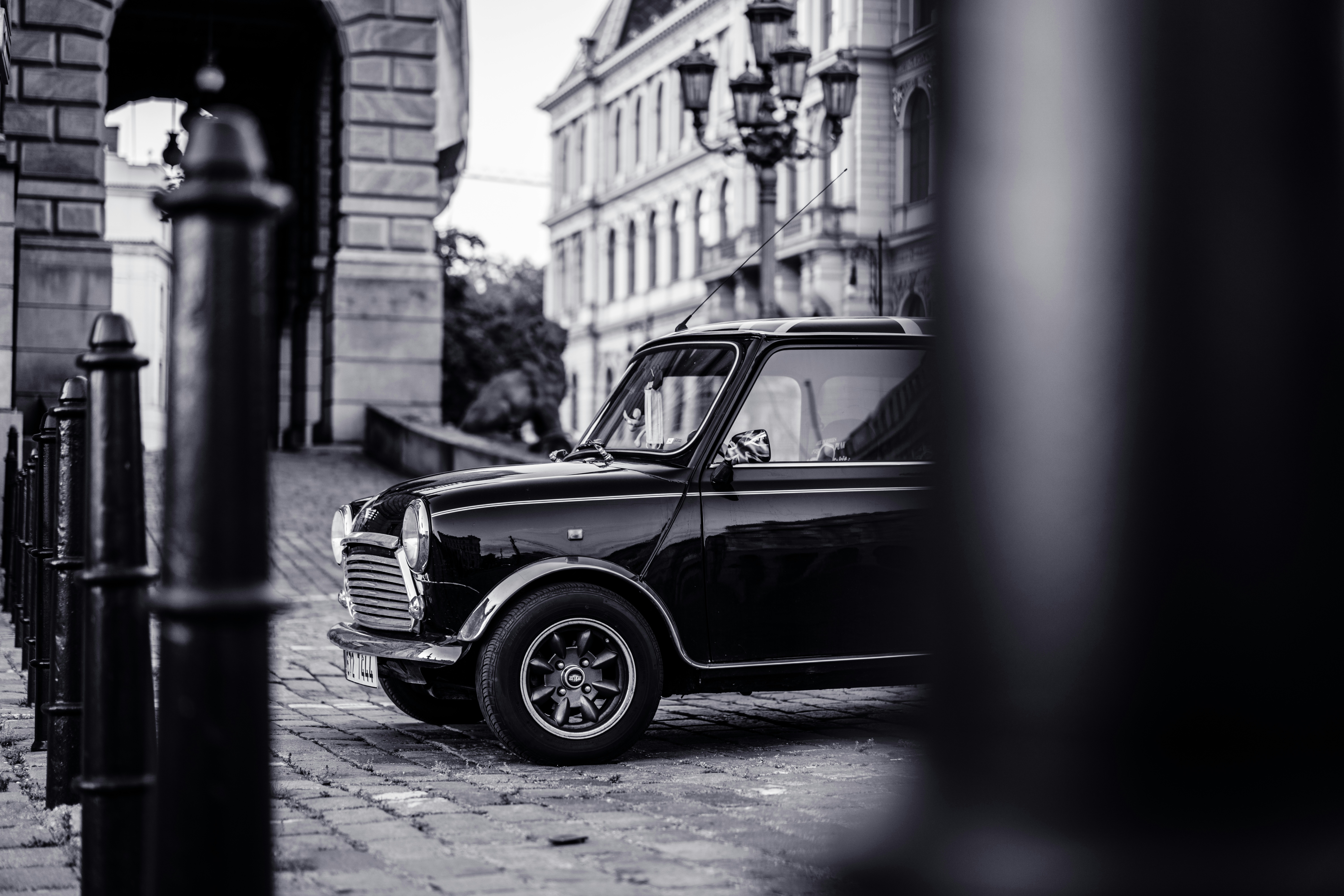
The car that resulted from this instruction became the best-selling British automobile in history. It changed the way cars were designed. It changed British popular culture. It lost money for most of its 41 years of production. It inspired a film, a fashion movement, and arguments about accounting that have never been entirely resolved. It was called the Mini.
The man who designed it
Sir Alec Issigonis was born in 1906 in Smyrna, in what is now Izmir, Turkey, to a Greek father and a German mother. He came to Britain in 1922 following the Greco-Turkish War, studied engineering at Battersea Polytechnic in London, failed his mathematics examination three times, and went on to become the most influential car designer Britain has ever produced. This is a useful reminder that formal qualifications and genuine ability are related but not identical things.
Issigonis joined Morris Motors in 1936 and designed the Morris Minor, which became the first British car to sell a million units. He left for Alvis, returned to BMC, and was given Leonard Lord’s brief to build a proper small car in 1957. The project was known internally as ADO15, standing for Austin Drawing Office project 15. It was rather more fun than the name suggests.
What he designed
Issigonis was given a box, approximately ten feet by four feet by four feet, and told to fit a proper four-seater car inside it. His solution was radical. Rather than mounting the engine longitudinally in the traditional manner, he rotated it ninety degrees and placed it transversely across the front of the car. The gearbox was placed beneath the engine, sharing the engine oil to save space. Drive went to the front wheels. The wheels were pushed to the absolute corners of the car to maximise interior space. The result was that fully 80 percent of the car’s floor plan was available for passengers and luggage, in a vehicle barely ten feet long.
Other solutions were equally unconventional. The suspension used rubber cones rather than conventional springs, a system developed with Alex Moulton that was compact, durable, and gave the car handling characteristics that would eventually embarrass much larger and more powerful vehicles. The seams where the body panels met were placed on the outside of the car rather than folded inward, simplifying manufacture and creating the distinctive external weld lines that became one of the Mini’s most recognisable visual features. The door hinges were also on the outside. The windows slid rather than wound down, which allowed thinner doors and created more elbow room and door pocket storage. The door pockets themselves, according to legend, were specifically sized to accommodate a bottle of Gordon’s gin and a bottle of vermouth, as those were the ingredients of Issigonis’s preferred dry martini.
The first prototype was running by the summer of 1957. Leonard Lord drove it and approved it for production almost immediately. The original prototypes used a 948cc version of BMC’s A-series engine. For the production car, this was reduced to 848cc to bring the Mini within a lower tax band, producing 34 brake horsepower. It was enough for a top speed of 72 miles per hour, which was perfectly adequate for the roads and speeds of 1959.
The launch and the price problem
The Mini was unveiled to the press in August 1959 and went on sale on August 26th of that year. In keeping with BMC’s habit of badge engineering, it was sold simultaneously as the Austin Se7en and the Morris Mini-Minor, the two versions being mechanically identical and differing only in their grilles and badges. The Austin name echoed the legendary pre-war Austin Seven. The Morris name suggested a smaller version of the Minor, also designed by Issigonis. The “Mini” prefix, initially just part of the Morris name, would eventually subsume everything.
The basic price was £496 including purchase tax. Leonard Lord had set this figure deliberately to undercut the bubble cars and make the Mini irresistible to the buyers he was targeting. The problem, which became apparent almost immediately, was that £496 was not enough money to build the car.
Ford’s engineers bought a Mini, stripped it to its component parts, and costed every piece against Ford’s own manufacturing costs. Their conclusion was that BMC was losing approximately £30 on every Mini sold, which at the time represented around six percent of the retail price. Ford’s Terence Beckett put this figure on record. BMC disputed it, pointing out that Ford and BMC had entirely different cost structures, different overhead allocation methods, and different approaches to how long a car needed to cover its development costs before turning profitable. All of this was true. The more uncomfortable truth, confirmed in 1973 when British Leyland’s own deputy chairman John Barber stated publicly that the Mini was still not a profitable model despite multiple price increases over fourteen years, was that the car had never been properly costed from the beginning.
The problem was partly structural and partly a question of accounting methodology. BMC’s cost allocation system was relatively primitive, sharing component costs across multiple models in ways that made it difficult to establish the true cost of any individual car. The A-series engine and gearbox were used across a range of BMC vehicles, and how their development and manufacturing costs were allocated between models affected whether the Mini appeared to make money or lose it. As one British Leyland executive later observed, altering the methodology for allocating shared overheads could push the Mini from profit to loss at the stroke of an accountant’s pen. The reality was that the car was genuinely labour-intensive to build, genuinely priced too aggressively, and genuinely never made the money it should have given the volumes at which it sold. Barber’s 1973 comment, that insufficient attention had been paid during the design stage to the inherent problems of production costs, was as diplomatic a way as possible of saying that Issigonis had been given a box and a brief and had not been asked to think too hard about what it would cost to fill it.
The slow start and the celebrity rescue
Initial sales were modest. Some buyers felt the Mini was simply too small for a proper family car. The early cars had problems: floors that leaked in rain, distributors that drowned in deep puddles, and a level of refinement that made it clear where the money had and had not been spent. Owners learned to carry a can of WD40 in the door pocket alongside whatever else Issigonis had intended to store there.
What saved the Mini was the people who bought it. Issigonis is said to have given Queen Elizabeth a ride around Windsor Great Park in one of the first cars built. Peter Sellers owned one, and then several more. Twiggy’s first car was a Mini, and BMC built her a special one with dark purple paint and tinted windows. Members of the Beatles drove them. The miniskirt designer Mary Quant, whose favourite car was a Mini, reputedly lent her name to both: the miniskirt was named after the car, and when asked about the connection she observed that neither was any longer than necessary, which is one of the better observations made about either subject. The Mini became the car of the 1960s not because of marketing but because the people who defined the decade chose to drive it.
John Cooper and the performance Mini
Issigonis was a practical engineer with a deep suspicion of anything that smelled like a marketing exercise, and he initially wanted nothing to do with a performance version of his small car. John Cooper, his friend and the designer of Formula One cars that had won World Championships, disagreed. Cooper had already used the A-series engine in his Formula Junior racing cars and could see the potential for a quick road car. When Issigonis turned him down, Cooper went directly to BMC’s managing director George Harriman, who agreed to produce 1,000 cars for motorsport homologation purposes. Neither man had any idea what they had started.
The Mini Cooper went on sale in 1961 with a 997cc engine, twin SU carburettors, front disc brakes, and an improved gearbox. It produced 55 brake horsepower and achieved 85 miles per hour, which was considerably more than the standard car’s 72. The Cooper S followed in 1963, initially with a 1071cc engine and subsequently in 970cc and 1275cc versions optimised for different racing classes. The 1275cc Cooper S became the definitive competition Mini and the car that most people picture when they hear the name today.
Monte Carlo and the disqualification that made history
The Mini Cooper S won the Monte Carlo Rally in 1964, 1965, and 1967. The 1966 result is the one that people remember most vividly, and it did not go to the Mini. Paddy Hopkirk, Timo Makinen, and Rauno Aaltonen finished first, second, and third in Monte Carlo, a clean sweep that should have been one of the great moments in British motorsport. The French organizers, apparently tired of their premier event being dominated by British cars, disqualified all three on a technicality involving the specification of the cars’ headlights. The ruling was disputed bitterly and widely regarded as unjust at the time, and nothing in the subsequent fifty years has given anyone reason to revise that view. The Mini won the following year instead, which was satisfying but did not entirely compensate.
The Italian Job
In 1969, the Mini appeared in a film that would do more for its reputation than any advertising campaign could have achieved. The Italian Job cast three Mini Cooper S models as the co-stars of a gold bullion heist in Turin, and the chase sequences through the city’s streets, arcades, and rooftops became among the most famous in cinema history. The film’s final line, as the coach containing the gold and the gang teeters on the edge of a cliff in the Alps, is one of the best-known in British film. The Minis escape the cliff rather better than the gang does, which seems appropriate for a car that proved more durable than the company that made it.
Evolutions and the long middle period
The Mini was updated throughout its life while remaining fundamentally the same car. The Mk II arrived in 1967 with a redesigned grille, a larger rear window, and various mechanical improvements. Hydrolastic interconnected suspension had been introduced in 1964, providing a softer if slightly more wallowing ride compared to the original rubber cone system, but was eventually abandoned in 1969 when the costs of the system outweighed its benefits and the original rubber cones were reinstated. The Clubman variant, introduced in 1969, offered a longer nose with a more modern squared-off front end that divided opinion but improved under-bonnet access considerably.
BMC also produced upmarket variants to extract more profit from the platform. The Wolseley Hornet and Riley Elf added three-box boot sections and more luxurious interiors, while independent coachbuilders Radford and Wood and Pickett produced extraordinarily expensive bespoke versions for wealthy customers who wanted something small but did not want anyone to mistake them for people who bought things because they were practical. Paul McCartney’s Radford de Ville Cooper S eventually sold at auction for £182,000, which is several orders of magnitude above what Leonard Lord had in mind when he specified a ten-foot box.
British Leyland and the years of slow decline
The merger that created British Leyland in 1968 brought the Mini under new and increasingly troubled management. The Mini remained in production, continued to sell, and continued not to make money. By the mid-1970s a new dimension had been added to the financial difficulties: the rear subframe, which was a known rust trap in the British climate, was failing on cars at a rate that had become remarkable. By around 1975, British Leyland was purchasing more replacement rear subframes from its supplier GKN than it was buying subframes to install in new cars on the production line. The replacement parts business had, in other words, become larger than the new car production business for that specific component. This was good news for GKN and rather pointed commentary on both the car’s construction and the British climate.
Various attempts were made to reduce the Mini’s production costs and improve its profitability, and various replacement programmes were proposed and cancelled. The Metro, which arrived in 1980, was intended to supersede the Mini but instead sold alongside it. The Mini stubbornly refused to be discontinued, partly because it kept selling and partly because no one at British Leyland, and subsequently the Rover Group, could quite bring themselves to end something that remained so recognisable and so loved.
The end of the original and the arrival of something new
BMW acquired the Rover Group in 1994 and immediately identified the Mini brand as an asset worth retaining regardless of what happened to the rest of the business. Production of the original Mini continued until October 1, 2000. The last car rolled out of the Longbridge factory with Lulu and Twiggy in attendance, two of the defining faces of the decade that the Mini had helped to create thirty years earlier. Over five million original Minis had been built across 41 years of continuous production, making it one of the most successful automotive programmes in history and, given the persistent questions about its profitability, one of the most expensive successes anyone had ever managed.
BMW had been working on a successor for years. The new MINI, note the uppercase letters, was unveiled at the Paris Motor Show in September 2000, just weeks before the last original left the line. It was larger, safer, more refined, more expensive, and considerably more profitable than its predecessor. It was built in Oxford rather than Birmingham. Whether it captured the spirit of what Issigonis had created in 1957 or simply the aesthetics is a question that classic Mini owners have been arguing ever since, and the argument shows no signs of resolution.
What the Mini left behind
The transverse front-wheel drive layout that Issigonis pioneered in 1959 became the standard configuration for almost every small car built anywhere in the world in the decades that followed. The Mini’s influence on automotive engineering is not merely British. It is universal. When you drive any modern front-wheel-drive car, the fundamental arrangement of its major components owes something to the decision taken in a BMC design office in 1957 to turn an engine sideways and put the gearbox in the sump.
The original Mini is now genuinely historic, with all examples over forty years old qualifying for historic vehicle status and exemption from Vehicle Excise Duty. The classic Mini buyers guide covers what to look for when viewing one today, and our rust prevention guide is particularly relevant given what the rear subframe statistics from the 1970s suggest about how enthusiastically the original cars returned themselves to their component materials. The classic car price checker shows current values, which have risen considerably since the days when Leonard Lord was trying to sell them for £496 and losing money in the process.
Of all the stories in British motoring history, the Mini’s is perhaps the most characteristically British: a genuine work of engineering genius, produced at a loss, driven by celebrities, used to rob a bank in Turin, worn out by rain, and loved so unreasonably and so persistently that it lasted forty-one years beyond anyone’s original expectations. Issigonis failed his mathematics examination three times. He only needed to pass once.
This page contains affiliate links. If you click a link and make a purchase, Classic Car Hub may earn a small commission at no extra cost to you.