
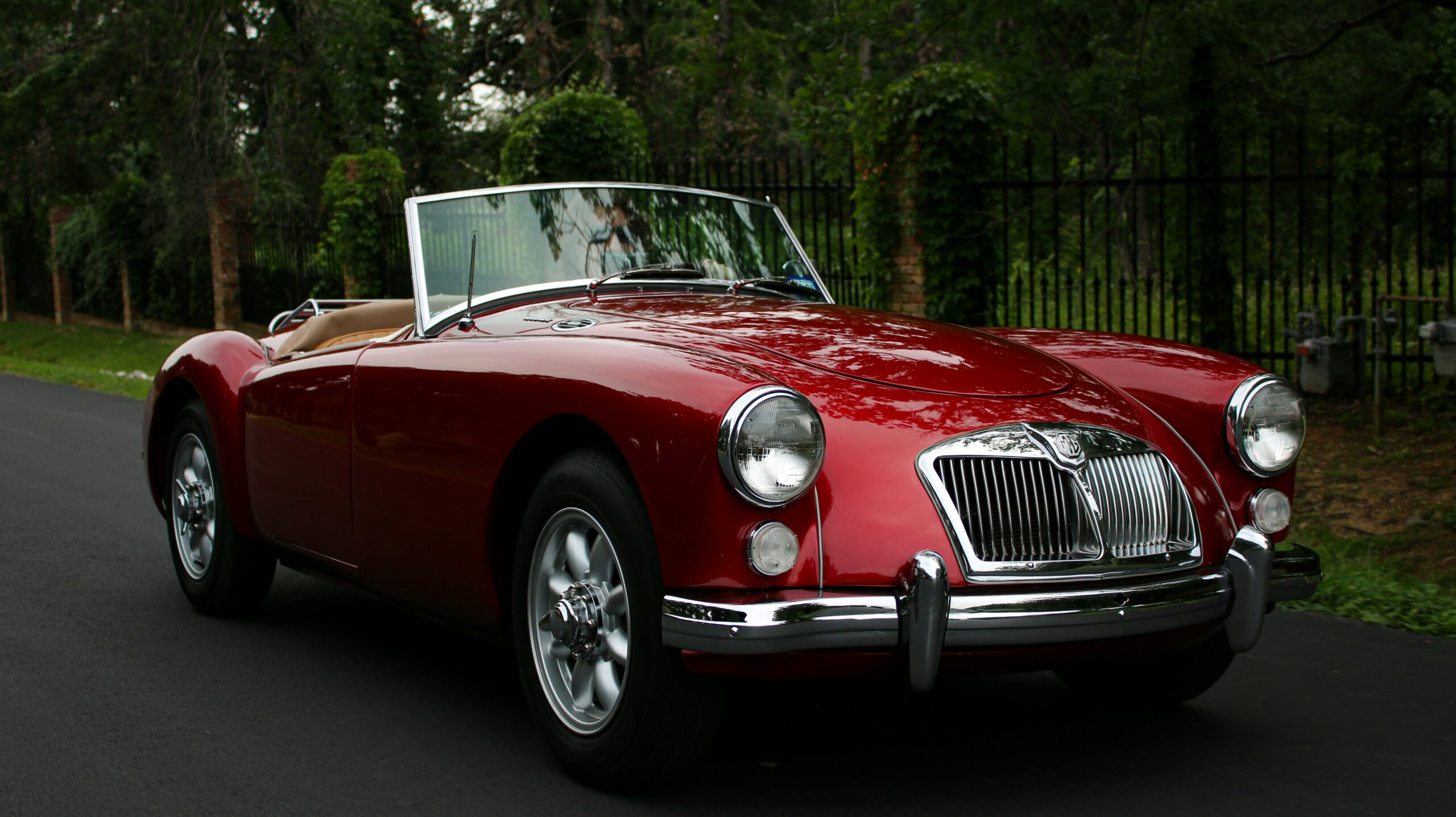
The MGA occupies an awkward position in the affections of the buying public, and the awkwardness is almost entirely geographical. It sits between two more famous cars. Behind it is the T-series, particularly the TF, which has the prewar aesthetic and the traditionalist following. Ahead of it is the MGB, which is more plentiful, better supported, and does everything a road car needs with less drama. The MGA, launched in 1955 and discontinued in 1962, is squeezed between these two and consequently underrated, underpriced relative to what it actually is, and slightly overlooked by people who would love it if they drove one. It is a genuinely pretty car, the first MG with a properly streamlined body rather than a traditional upright design, and it drives with a precision and lightness that the MGB, for all its virtues, does not quite replicate.
The MGA also contains a specific model variant that is one of the most interesting and technically ambitious small sports cars of the late 1950s, sold in tiny numbers, frequently misunderstood, and capable of causing significant expense if bought without proper understanding of what it is and what it requires. The Twin-Cam deserves its own section, and it will get one.
The variants
MGA 1500 (1955 to 1959) used the BMC B-Series engine in 1,489cc form producing 68 brake horsepower. Drum brakes all round. The roadster is by far the more common body style; the fixed-head coupé, with its graceful steel roof, is rarer, more practical in poor weather, and currently carries a slight premium in the market for that rarity. Total production of the 1500 was 58,750, making it the most numerous MGA variant and the starting point for most buyers looking at the model for the first time. The 1500 is the car to choose if originality and period correctness matter most; if you want the better brakes, read on.
MGA 1600 Mk I (1959 to 1961) added front disc brakes via a Lockheed system, which transformed the car’s stopping capability from adequate to genuinely good. The engine gained 8 brake horsepower, revised rear lights improved visibility to following traffic, and sliding sidescreens replaced the earlier type. The 1600 is the pick of the pushrod cars for anyone who intends to drive in modern traffic conditions: the disc brakes make a meaningful difference in real-world use, and the production run of 31,501 means examples are not difficult to find.
MGA 1600 Mk II (1961 to 1962) is the rarest pushrod MGA, with only 8,719 built. The engine was enlarged to 1,622cc, producing 86 brake horsepower, and the car received a revised grille and horizontal rear lights that make it visually distinguishable from the Mk I. The Mk II is the quickest and most developed of the pushrod MGAs, and its rarity gives it a modest premium over the Mk I in the current market.
The Twin-Cam: a different proposition entirely
The MGA Twin-Cam, produced between 1958 and 1960 in a total run of just 2,111 cars, deserves to be considered as a separate buying decision rather than simply a more powerful MGA. It shares the standard car’s body and suspension geometry but almost nothing mechanical. The engine is a 1,588cc twin-overhead-camshaft unit producing 108 brake horsepower at 6,700 rpm, developed by MG’s engineers from the B-Series block. The brakes are four-wheel Dunlop discs with centre-lock disc wheels. The performance was genuinely impressive for its era and the car’s chassis is well-matched to the engine’s outputs.
The reason the Twin-Cam requires a separate section is that it also developed a reputation for oil consumption, holed pistons, and head gasket failures that was serious enough that MG ultimately discontinued it after less than two years. The root cause was a combination of a high compression ratio (initially 9.9:1, later reduced to 8.3:1 in an attempt to address the problem) and a sensitivity to running conditions that the pushrod B-Series does not have. A Twin-Cam run lean, overheated, or maintained with anything less than strict attention to oil changes will develop problems that a pushrod car would absorb without complaint. In the hands of an owner who understands it and maintains it correctly, using the later lower-compression pistons and the right oil specification, the Twin-Cam is a remarkable and rewarding car. In the hands of an owner who does not understand what they have bought, it is a source of continuing expense.
All Twin-Cams were sold with a “De Luxe” specification option alongside the standard cars. After Twin-Cam production ended in 1960, MG produced a small number of 1600 De Luxe cars (395 in total) using the Twin-Cam’s brakes, wheels, and running gear with the standard pushrod engine. These De Luxe roadsters and coupés offer the four-wheel disc brakes and wire wheels of the Twin-Cam without the engine complexity, and they are sought after by knowledgeable buyers who want the best braking in a pushrod package.
What to look for
Bodywork and structure
The MGA has a body-on-frame construction: a steel ladder chassis with a separate steel body. Both components rust independently and both need to be checked. The chassis rails, particularly in the forward section under the engine bay and at the rear below the boot floor, are the primary structural concern. Prod the chassis rails firmly with a screwdriver blade at the most accessible points to check for softness. The outer body panels rust in the usual locations: door bottoms, front wings where they meet the running boards, rear wing lower sections, and below the battery on the right-hand wing where acid damage accelerates corrosion. Lift the floor coverings and check the floor itself: a good floor is the foundation of a usable MGA and a bad one is a significant project item.
Check the inner front wings for filler: the area behind the headlamps is frequently repaired cosmetically without addressing the underlying rust properly. The sills on the MGA are structural components; replace them with incorrect or lightweight sections and the car’s rigidity is compromised. Any sill that sounds hollow when tapped firmly needs proper investigation before purchase.
Mechanicals
The B-Series engine in pushrod form is one of the most proven units in British classic car history and does not require excessive concern beyond the standard checks. Healthy oil pressure at 3,000 rpm, no significant blue smoke, no bearing rumble at idle, and a clean oil filler cap without the creamy emulsion that indicates a head gasket issue. The gearbox is reasonably robust but listen for a whine in second gear, which is the most common wear point on MGAs that have covered significant mileage. The rear axle is generally reliable: check for oil leaks at the half-shaft seals and any significant clonk on drive take-up that would indicate worn differential components.
On the Twin-Cam, the valve clearances must be checked with a warm engine to the correct specification. Incorrect valve clearances are the most common cause of the piston damage that gave the Twin-Cam its early reputation. If buying a Twin-Cam, the service history should confirm that valve clearances have been checked and maintained regularly. A compression test is essential: all four cylinders should show consistent readings of at least 150 psi on a healthy engine with the later 8.3:1 compression ratio. Significant variation between cylinders, or readings below 130 psi on any cylinder, indicates a problem worth investigating before money changes hands.
On screen
The MGA appeared in numerous British films of the late 1950s and early 1960s as the car of choice for the aspirational young professional: the era when a sports car was within reach of someone on a good salary for the first time, and the MGA was the British answer to that moment. It has not had a single defining screen appearance in the way that the E-Type has Harold and Maude or the Big Healey has its Tears for Fears cameo, but its background presence across a generation of British cinema is consistent enough to carry its own cultural weight. If a British film made between 1956 and 1963 contains a sports car that is not an Aston Martin, there is a reasonable chance it is an MGA.
The community
The MG Car Club is the primary organisation for all MG models and one of the largest single-marque clubs in the world, with over 10,000 members and a network of regional centres. Within the MGCC, the MGA Register maintains a specific focus on the MGA and Twin-Cam, with technical expertise, a spares scheme, and a register of known surviving cars. The Twin-Cam Register within the MGCC is particularly valuable for anyone buying or maintaining a Twin-Cam: the specific knowledge required to keep one running correctly is not widely available outside this community, and joining before the purchase is strongly recommended. Parts supply for the MGA is good for the common items through Moss Europe and Brown and Gammons; Twin-Cam specific components are more specialist but the register can advise on the best sources.
What to pay
Current market: MGA 1500 and 1600 roadsters from around £8,000 to £12,000 for a usable driver needing cosmetic attention, rising to £20,000 to £28,000 for a properly restored car in excellent condition. Fixed-head coupés carry a premium of approximately 10 to 20 percent over equivalent roadsters. MGA 1600 Mk II examples in good condition reach £25,000 to £35,000, reflecting the combination of rarity and the most developed pushrod specification. Twin-Cam roadsters in good, mechanically correct condition range from £18,000 to £40,000 depending on originality and engine condition: the spread reflects both the rarity of the model and the range of condition in which survivors are found. The De Luxe models occupy a similar price range to the Twin-Cam. For the Twin-Cam specifically, paying a premium for a properly maintained, correctly specified car with a demonstrable service history is consistently better value than paying less for one that has been neglected or incorrectly set up.
For related reading: our MGB buyers guide covers the MGA’s successor, our MG Midget buyers guide covers the smaller MG from the same era, our MG paint colour codes guide covers the full factory colour range, and our SU carburettor guide covers the carburettors fitted to all pushrod MGAs.
This page contains affiliate links. If you click a link and make a purchase, Classic Car Hub may earn a small commission at no extra cost to you.