
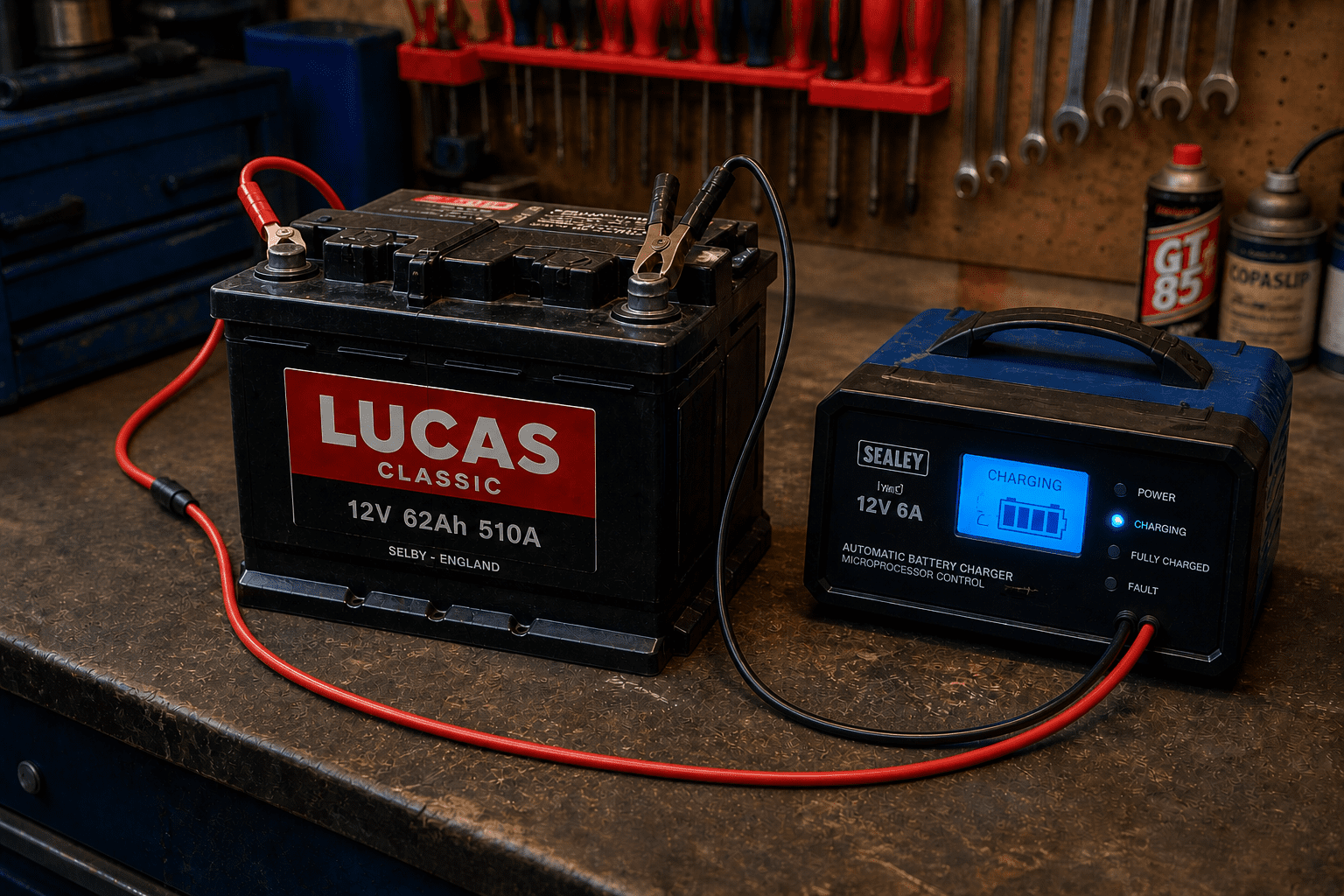
The battery is the most boring component on your classic car. Nobody buys a 1969 Triumph Spitfire because they have developed a passion for electrochemical energy storage. Nobody posts photographs of their battery on social media. Nobody at a concours d’elegance lingers admiringly over the engine bay going “yes, but have you seen the state of that negative terminal.” And yet, more classics are stranded by a dead battery than by any other single cause. It deserves rather more attention than it typically receives, which is to say any attention at all.
The basics: what you are dealing with
The vast majority of classic cars use a 12-volt lead-acid battery, though some pre-1960s cars use a 6-volt system. The lead-acid battery has been the automotive standard since the early twentieth century, which tells you either that it is a brilliantly effective design or that no one could be bothered to change it. Both things are probably true. The battery consists of lead plates submerged in a sulphuric acid electrolyte solution, and the chemical reaction between the two produces electrical current. Simple, effective, and entirely unpleasant to get on your clothes.
A fully charged healthy 12-volt battery should read between 12.6 and 12.7 volts when measured at rest with a digital multimeter. This is the open circuit voltage, measured when the car has not been driven for at least a couple of hours and no electrical loads are active. Below 12.4 volts, the battery is at less than roughly 75% charge. Below 12.0 volts, something has gone wrong. A reading much below that either means the battery has been left in a state of discharge long enough for serious damage to occur, or that someone has left the interior light on for three weeks, which is a different problem entirely.
Sulphation: the enemy within
The single most destructive thing that happens to a classic car battery is sulphation. It has a pleasingly dramatic name for a process that is essentially just a battery sitting quietly in a garage doing nothing, which is somehow more embarrassing than a proper mechanical failure. When a battery’s voltage drops below approximately 12.4 volts and stays there, lead sulphate crystals begin to form on the lead plates inside the battery. These crystals increase the battery’s electrical resistance, reducing its ability to accept or deliver charge. The longer the battery remains in this state, the larger the crystals become and the worse the damage. Eventually the battery becomes so resistant that it cannot be meaningfully charged at all.
Early stage sulphation can sometimes be partially reversed using a smart charger with a desulphation or reconditioning mode, which applies a pulsed charge designed to break down the crystals. Do not expect miracles. The battery will never return to full capacity once sulphation has taken hold, but it may become usable again if caught early. Severe sulphation is permanent and the battery needs replacing.
The practical lesson is straightforward: never leave your battery in a discharged state. Never. Not over winter, not while you sort out the bodywork, not while you wait for a part to arrive. A battery left flat for months in a cold garage is almost certainly developing sulphation, and a sulphated battery is a dead battery wearing a convincing disguise. This is why the pre-season check on any car coming out of storage should always include checking the battery voltage before anything else. Our pre-season safety check guide covers the full inspection routine.
Temperature: cold is not your battery’s friend
Lead-acid batteries dislike cold weather for two distinct reasons, and it is worth understanding both. First, cold temperatures slow the chemical reactions inside the battery, reducing its ability to deliver current. A battery that would turn an engine over without complaint at 20 degrees Celsius may struggle noticeably at 0 degrees and may simply refuse at minus 10. The engine, meanwhile, requires more current to crank in cold weather because the oil is thicker and offers more resistance. The battery is asked to do more at the exact moment it is least capable of doing it. Winter is, from a battery’s perspective, comprehensively unfair.
Second, a discharged battery is vulnerable to freezing. At full charge, the electrolyte won’t freeze until temperatures reach around minus 70 degrees Celsius, a level so far below anything the British climate produces that a properly maintained battery is, for practical purposes, immune to freezing. At around 40% charge, that threshold rises sharply to somewhere between minus 8 and minus 10 degrees Celsius, well within range of a hard British winter. Fully discharged, the electrolyte is little more than water and can freeze close to zero. A battery left in a cold garage at partial charge in a British winter, which rarely gets that cold, is probably safe. But a battery that has been standing discharged for months and is sitting in an unheated outbuilding during a cold snap is at genuine risk, and a frozen battery is a destroyed battery. Keep it charged during storage, and this particular catastrophe does not occur.
The other consideration for long-term winter storage is self-discharge. Even a disconnected battery loses charge slowly over time, typically around 1 to 2% per week for a healthy lead-acid battery. Over three or four months of storage, this adds up. A battery that was at 100% charge in October may be below 12.4 volts, and therefore beginning to sulphate, by January. This is the core reason why a trickle charger or smart maintainer during winter storage is not optional. It is the difference between a battery that starts the car in spring and one that starts an argument about what went wrong.
Trickle chargers and smart maintainers
There is an important distinction between a simple trickle charger and a smart maintenance charger, and getting it wrong costs batteries. A traditional trickle charger delivers a small, constant current regardless of the battery’s state of charge. Left connected indefinitely, it will eventually overcharge the battery, producing excess heat and gas. It is better than nothing, but it requires monitoring. Leave it connected for three months and check back to find a dead battery, and the trickle charger will not have helped.
A smart charger, by contrast, monitors the battery’s voltage and adjusts its output accordingly. When the battery is fully charged, the charger switches to a float or maintenance mode, delivering just enough current to offset self-discharge without overcharging. The CTEK MXS 5.0 is the unit most frequently recommended in classic car circles, and for good reason. It also includes a desulphation mode for recovering partially damaged batteries. The Optimate range from TecMate is similarly well regarded. Either is money well spent and both will outlast several batteries if looked after. The small permanent connector lead that plugs into the charger and lives tidily under the bonnet is one of the more sensible accessories available for any classic car used seasonally.
One note on charging: always charge in a well-ventilated space. A battery being charged produces hydrogen gas as a byproduct, particularly in the final stages. Hydrogen is highly flammable. A spark near a charging battery in an enclosed space is the kind of excitement nobody is looking for. Open the garage door. It is not complicated.
Battery isolators and cut-off switches
Classic cars have parasitic electrical drains. Some of these are deliberate, such as a clock or an alarm if someone has fitted one. Many are accidental, the result of decades of previous owners adding things in ways that were not entirely thought through, leaving circuits that never quite switch off. A classic car left parked with its battery connected for several weeks will often return to a flat battery, sometimes for no immediately obvious reason. An isolator switch is the solution.
A battery isolator, also called a cut-off switch or kill switch, is a simple rotary switch fitted in the battery circuit, usually on the negative terminal. Turning it to the off position breaks the circuit completely, eliminating all parasitic drain. The battery cannot go flat because nothing can draw current from it. For cars in long-term storage, or for those with known electrical gremlins, an isolator is a straightforward and inexpensive fix. A basic isolator switch costs very little and takes an hour to fit.
One important note: always fit an isolator switch to the earth return terminal, not the live terminal. On negative earth cars, which covers the vast majority of British classics built from the mid-1960s onwards, this means the negative terminal. On positive earth cars, which includes many British classics built before approximately 1965 to 1967 including early MGBs, early Spitfires, and Morris Minors of that era, this means the positive terminal. If you are unsure which system your car uses, check the workshop manual or ask the relevant owners club before fitting anything. Getting this wrong creates a live disconnected wire in the engine bay, which is a fire and short circuit risk.
The one drawback of an isolator switch is that disconnecting the battery resets any electronic components that rely on continuous power. On most classic cars of the 1960s and 1970s, there are very few such components, making the isolator an obvious choice. On later classics with trip computers, radio presets, or other electronics, the inconvenience is more significant but usually still worthwhile.
Fluid levels in flooded lead-acid batteries
Many classic car batteries are traditional flooded lead-acid units with removable cell caps. These require periodic attention to electrolyte level. The electrolyte is a mixture of sulphuric acid and distilled water, and the water component gradually evaporates over time, particularly in warm conditions or after heavy charging. If the electrolyte level drops below the top of the lead plates, those plates are exposed to air, sulphate rapidly, and die. Checking the level takes thirty seconds. Ignoring it is how you destroy a perfectly serviceable battery for no reason.
Remove the cell caps and look inside each cell. The electrolyte should cover the plates by approximately 10 to 15 millimetres. If it is low, top up with distilled water only. Not tap water, which contains minerals that contaminate the electrolyte and accelerate plate damage. Not deionised water from the supermarket either, which sounds similar but is not the same thing. Distilled water, which is widely available and costs very little. Top up to just above the plates, replace the caps, and you are done. If a cell is significantly lower than the others and needs topping up frequently, that cell may be failing.
Sealed or maintenance-free batteries do not have removable caps and cannot be topped up. They are designed to recapture the water vapour internally during charging. If a sealed battery is losing electrolyte, something has gone seriously wrong and the battery needs replacing rather than nursing.
Signs of impending battery failure
Batteries rarely fail without warning. The warning signs are often ignored, which is why so many people are surprised by a dead battery on a cold morning. Pay attention to these indicators and you will almost always get advance notice of a failing battery rather than an unscheduled visit from a recovery driver.
- Slow cranking: If the starter motor turns the engine over noticeably more slowly than usual, particularly when the engine is cold, the battery is struggling. This is one of the most reliable early warning signs of a battery that is losing capacity.
- Voltage below 12.4 volts at rest: A battery that consistently reads below 12.4 volts after standing overnight has either been discharged by a parasitic drain or is no longer capable of holding a full charge. Charge it fully and check again. If the voltage drops back rapidly with no obvious drain, the battery is failing.
- Dim lights on start-up: If the headlights or interior lights dim significantly when you turn the ignition key, the battery’s internal resistance has increased, causing the voltage to drop sharply under load. This is classic sulphation behaviour.
- Swollen or distorted case: A battery case that has swelled, bulged, or cracked has been seriously overcharged or overheated. Do not attempt to use or charge it. Replace it and investigate why it overheated.
- Corrosion on terminals: A powdery white or bluish-green deposit on the battery terminals is a sign of either a poor connection, overcharging, or a small leak from a cell. Clean the terminals with a wire brush, apply a thin coat of petroleum jelly to protect them, and investigate the cause if the corrosion returns quickly.
- Age: A well-maintained lead-acid battery in regular use typically lasts four to five years. One that has been in storage for long periods without maintenance may last considerably less. If you do not know how old the battery is, check the date code stamped on it. Most manufacturers stamp a month and year code directly onto the case. If you cannot find a date or the battery is more than five years old, budget for replacement.
- The battery needs regular jump starts: This one should be obvious, but it is remarkable how many people treat requiring a jump start every few weeks as an acceptable situation rather than a clear signal that the battery needs replacing.
The load test: the definitive health check
Voltage alone does not tell you everything about a battery’s condition. A battery can show a resting voltage of 12.6 volts and still fail to start the car because it cannot maintain that voltage under the load of cranking the engine. The load test reveals this. A proper load tester applies a current equivalent to half the battery’s cold cranking amp rating for 15 seconds while monitoring the voltage. A healthy battery should maintain at least 9.6 volts throughout the test. A battery that drops below this, even momentarily, has degraded internal plates and is approaching the end of its usable life.
Most motor factors, battery specialists, and some larger garages will perform a load test for free. It is worth doing annually on any classic car, and before any long journey. The cold cranking amp rating on the replacement battery should match or exceed the original specification for the car, particularly if you drive it through winter. This rating, abbreviated CCA, tells you how many amps the battery can deliver for 30 seconds at minus 18 degrees Celsius while maintaining at least 7.2 volts. The higher the number, the more confidently the battery will start the car on a cold morning.
Putting it all together
The battery maintenance routine for a classic car used seasonally is not complicated. Before winter storage, charge the battery fully, fit an isolator switch to the negative terminal if you have not already, and connect a smart maintenance charger for the duration of storage. Check the electrolyte level on any flooded battery and top up with distilled water if needed. In spring, check the resting voltage before attempting to start the car, and have the battery load-tested if it has been in storage for several months without a maintainer connected. Replace any battery that is more than five years old, consistently under-performing, or showing signs of physical damage.
It is genuinely unglamorous. But a classic car that starts first time, every time, and never leaves you stranded with a flat battery in a layby is considerably more enjoyable than one that is immaculately restored in every respect except the one that actually makes it go. For everything else you need to check before your first drive of the season, our pre-season safety check guide covers the full picture, and our winter storage guide has the complete lay-up procedure including battery preparation.
This page contains affiliate links. If you click a link and make a purchase, Classic Car Hub may earn a small commission at no extra cost to you.