
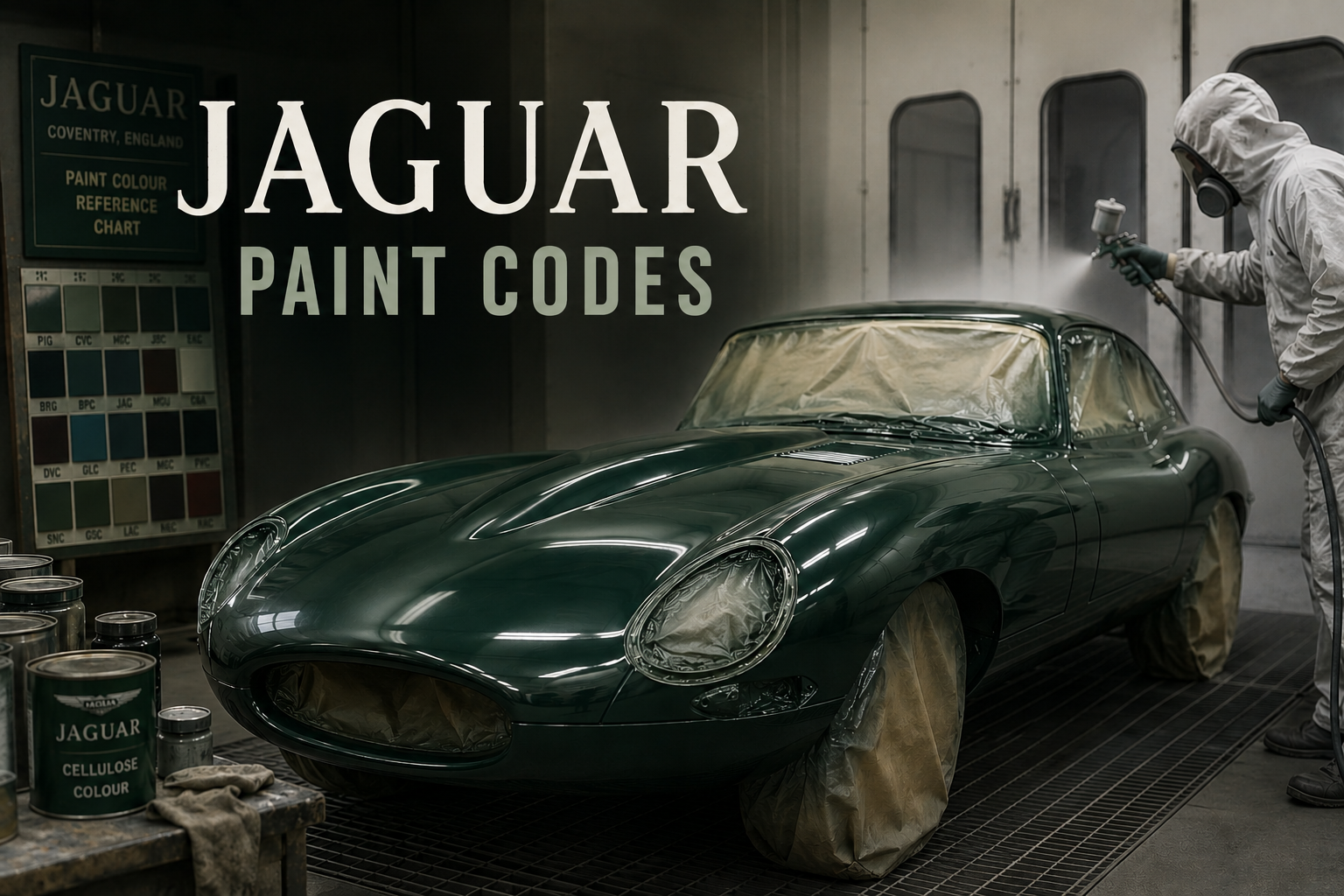
Jaguar colours are amongst the most evocative in the classic car world. The deep opalescent blues of the early E-Type. The almost-black British Racing Green of the late XJ-S. The warm Pale Primrose that appeared on so many XJ6 saloons in the early 1970s and managed to look dignified rather than merely pale. Jaguar took colour seriously, and for much of the classic era worked closely with Glasurit (BASF) to produce a palette that ranged from the expected to the genuinely unusual. This guide covers the main classic models from the XK series of the late 1940s through to the XJ-S, with confirmed factory codes and approximate digital swatches for each colour.
One point worth making at the outset: a significant proportion of the most desirable Jaguar colours of the 1959 to 1968 period were opalescent finishes. These are metallic paints produced with very fine metal flakes that create a depth and luminosity that shifts with the viewing angle and the light. No flat digital swatch can reproduce this effect. The opalescent colours in this guide are necessarily represented as flat approximations of their base hue. Anyone restoring an opalescent car should treat the swatches here as orientation only and work with a specialist paint supplier using the factory code for an accurate match.
Also worth noting: Jaguar paint codes from this era were largely shared with other cars produced under the BMC umbrella, including Austin-Healey, MG, and Wolseley. The Glasurit codes listed here cross-reference directly to those marques, which is sometimes useful when sourcing paint for a restoration from a supplier who specialises in BMC vehicles rather than Jaguar specifically.
Jaguar Colour Notes Worth Knowing
Understanding Jaguar paint codes
Jaguar used a coding system developed in conjunction with Glasurit (BASF) as the primary paint supplier throughout the classic era. The original Jaguar codes consist of a JA prefix followed by a three-digit number: JA001 for Battleship Grey, JA023 for British Racing Green, and so on. These JA codes appear in older parts and restoration literature and are still the most reliable reference for identification. Glasurit also assigned their own numeric codes (such as 7414 for British Racing Green or 7407 for Dark Blue), and these Glasurit numbers are the ones most commonly used by paint suppliers today when mixing from original formulas. Both codes are given in this guide where known.
The opalescent colours introduced from around 1959 carry an A or S suffix on the Glasurit number, indicating the metallic additive system used. These suffixes are relevant to paint suppliers and restorers mixing from formula.
Finding the paint code on your car
On XK series and early saloon Jaguars, the colour is typically recorded on the chassis plate in the engine compartment, usually on the bulkhead or inner wing. The colour will be given by name rather than code on earlier cars. From the E-Type era onwards, the paint code appears on a separate trim and colour identification plate located in the engine compartment or on the driver’s door jamb, depending on the model and year. The most reliable source for confirming the original colour of any classic Jaguar is a Heritage Certificate from Jaguar Heritage, which documents the original specification from factory build records.
Jaguar XK120, XK140 and XK150 (1948–1961)
The XK series launched Jaguar into the sporting world with a palette that reflected the post-war era. Early cars were available in a relatively restrained range of greys, blues, reds, and greens. The XK150 from 1957 introduced a broader range including the distinctive Opalescent finishes. Colours were recorded by name on the chassis plate.
✦ Denotes an opalescent or metallic finish. Digital representation is a flat approximation only.
Jaguar Mk1, Mk2, S-Type and 420 (1955–1969)
The compact saloons represented Jaguar’s most commercially successful cars of the era. The Mk2 in particular became a British institution, appearing in every colour from Battleship Grey to Opalescent Maroon. This was the period of Jaguar’s most adventurous colour work, with the opalescent range introduced in 1959 adding genuine depth and drama to the palette.
✦ Denotes an opalescent or metallic finish. Digital representation is a flat approximation only.
Jaguar E-Type Series 1, 2 and 3 (1961–1975)
The E-Type’s colour palette evolved significantly across its production life. Series 1 cars (1961–1968) are most closely associated with the opalescent colours, particularly Opalescent Dark Green and Opalescent Silver Blue. From Series 2 (1968), the palette shifted to brighter solid colours with the opalescents largely phased out. The Series 3 V12 (1971–1975) offered a broader range including Pale Primrose and the warm fawn tones. Jaguar would paint to special order in almost any colour, so non-standard colours do appear with documented provenance.
✦ Denotes an opalescent or metallic finish. Digital representation is a flat approximation only.
Jaguar XJ6 and XJ12 Series 1, 2 and 3 (1968–1992)
The XJ series ran for over two decades and its colour palette evolved accordingly. Early Series 1 cars from 1968 shared much of the E-Type’s palette. Series 2 and Series 3 cars saw the addition of new colours including the grey-green Fern Grey, the late 1970s Lavender Blue, and an extended range of blues. Regency Red remained available almost throughout the entire XJ production run, making it one of the longest-running factory colours in Jaguar’s history.
Jaguar XJ-S (1975–1996)
The XJ-S ran for an extraordinary 21 years, and its later colour palette reflects both the changing tastes of its era and Jaguar’s move under Ford ownership towards a more contemporary palette in the late 1980s and early 1990s. The original JA code colours were gradually supplemented and then replaced by a new three-letter code system. The classic-era colours listed here cover the 1975 to mid-1980s period. Regency Red persisted almost to the end of production in a revised formulation. Later XJ-S colours from the mid-1980s onwards used the newer three-letter codes, of which BPB (Bordeaux Red), EAC (Racing Green), and BFD (Kingfisher Blue) are among the most recognised.
Codes verified from Glasurit/BASF Jaguar paint reference (classicjaguar.com) and cross-referenced with PPG paint code databases. Year ranges are approximate factory catalogue dates. Jaguar routinely painted cars to special order outside the standard catalogue, so non-standard colours can appear with documented heritage. Always verify original colour against a Jaguar Heritage Certificate for restoration work. Classic Car Hub accepts no liability for painting or restoration decisions made on the basis of this information.
This page contains affiliate links. If you click a link and make a purchase, Classic Car Hub may earn a small commission at no extra cost to you.