
The question of whether to convert your classic car from points to electronic ignition provokes strong feelings in the classic car community, which is perhaps surprising given that both systems are trying to achieve exactly the same thing. Produce a spark at the right moment, do it reliably, and keep doing it for as long as possible without requiring constant attention. Points have been doing this since the dawn of the motor car. Electronic ignition does it differently and, in some respects, better. Whether better is the point depends entirely on what you want from your classic and how you feel about adjusting points on a cold Saturday morning with freezing hands and a torch held between your teeth.
How points ignition works
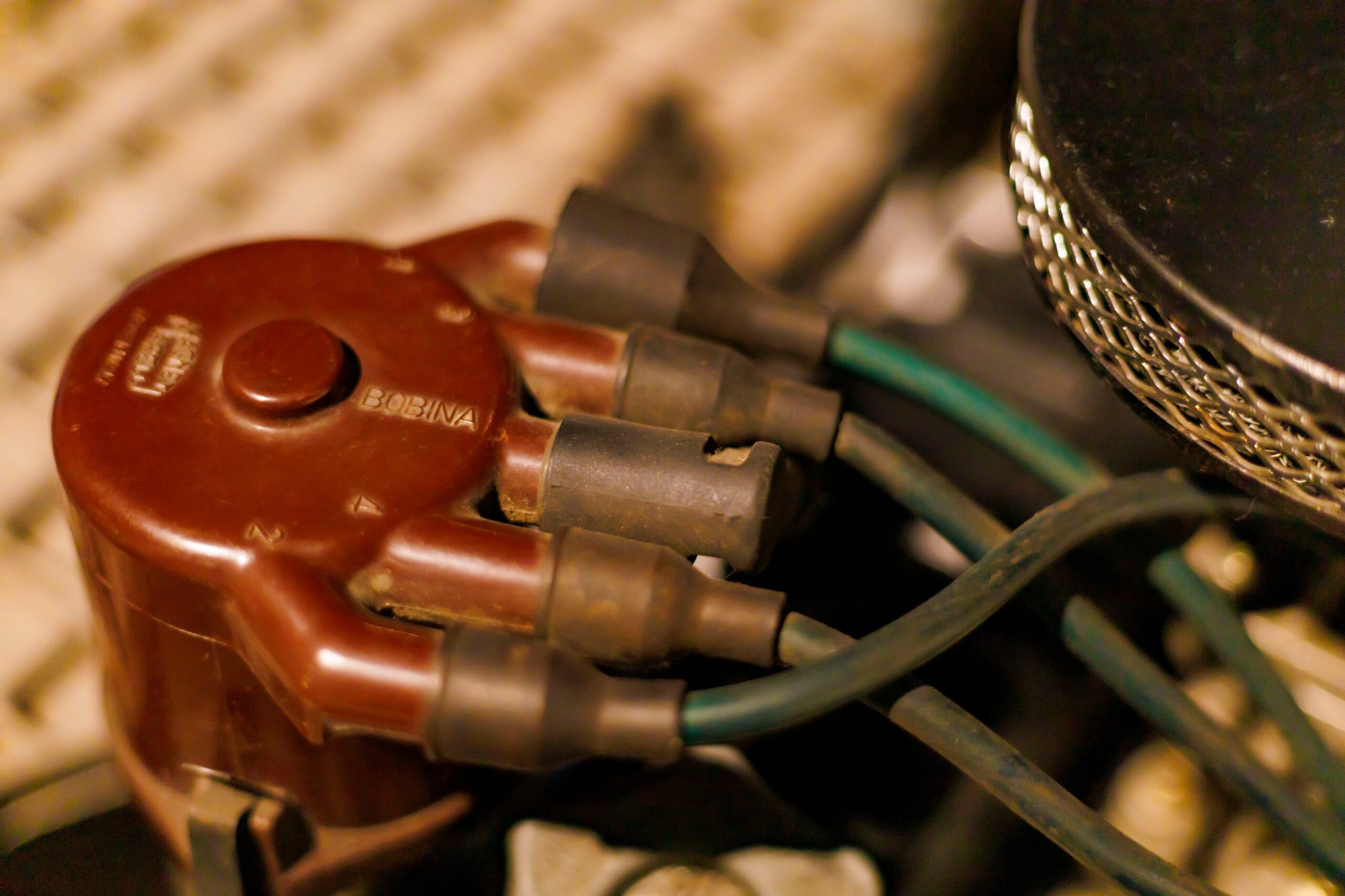
Understanding why anyone would want to replace points requires understanding what points actually do. Inside the distributor, a set of contact breaker points is opened and closed by lobes on the rotating distributor shaft, one lobe per cylinder. When the points close, current flows through the ignition coil’s primary windings and builds up a magnetic field. When the lobe opens the points, that current is abruptly interrupted, the magnetic field collapses, and the resulting inductive spike is amplified by the coil’s secondary windings into a high voltage pulse of several thousand volts. That pulse travels down the king lead to the centre of the distributor cap and is distributed to the correct spark plug by the rotating rotor arm. The plug fires, the mixture ignites, the power stroke happens. Do this four or six or eight times per revolution and you have a running engine.
A condenser fitted in parallel with the points absorbs the arc that would otherwise burn the contact surfaces every time the points open. Without the condenser the points burn rapidly. With a failing condenser they burn slightly less rapidly but still fail, often at inconvenient times and places.
The mechanical simplicity of this system is genuine. There are very few components. Every part can be carried as a spare in the glovebox. A competent owner can diagnose and fix most points ignition faults at the roadside with a screwdriver and a feeler gauge. For many years it was, rightly, considered a perfectly adequate system for the purpose.
How electronic ignition works
Electronic ignition replaces the mechanical points and condenser with a solid-state switching system, typically using either a magnetic Hall effect sensor or an optical sensor to detect the position of the distributor shaft and trigger the coil at the correct moment. There are no moving parts in contact with each other, no surfaces to wear or burn, and no condenser to fail. The distributor itself, the cap, rotor, and advance mechanism all remain in place on most conversion kits. Only the points and condenser inside the distributor are replaced.
On most classic British cars the conversion involves fitting a trigger module to the distributor baseplate, a trigger disc or magnet to the distributor shaft, and connecting two wires to the coil. The whole job typically takes under an hour and is within the ability of anyone comfortable with basic electrical work. The original distributor body remains in the car and the conversion is hidden under the cap, which matters to those who want the engine bay to look standard.
The case for converting
Reduced maintenance
This is the main argument and it is a genuine one. A points ignition system requires checking and adjustment every three to six thousand miles under normal use. The contact gap must be set correctly for the dwell angle to be right, and the dwell angle must be right for the timing to be accurate, and the timing must be accurate for the engine to run at its best. Get any of these out of tolerance and performance, fuel economy and reliability all suffer. Electronic ignition has no wearing contacts and requires no routine adjustment once correctly set up. The timing stays where you put it, indefinitely, without drift.
Better spark quality at high revs
Points ignition has a fundamental limitation at high engine speeds. As revs rise, the time available for the coil to charge between each points opening reduces. Above a certain RPM the coil does not fully charge before it is triggered again, which means a weaker spark at precisely the moment you need the strongest one. Electronic systems address this by maintaining consistent dwell time at lower revs and adjusting it optimally at higher revs, ensuring the coil is fully charged across the rev range. The practical benefit is more reliable ignition and slightly better high-rev performance.
Parts quality has declined
This is a less obvious but genuinely important consideration. The quality of replacement points and condensers available today is, by general consensus among experienced classic car mechanics, considerably worse than the components they replace. The volumes required to justify manufacturing high quality points are no longer there. Modern condensers in particular have a poor reputation for premature failure. If you are relying on points ignition and the components you are putting in are of questionable quality, you are not actually getting the benefit of the system’s simplicity because the parts are letting it down. An electronic conversion removes this variable entirely.
Cold starting and hot starting
Electronic ignition provides a stronger, more consistent spark across a wider range of conditions than points. This is most noticeable on cold mornings and in hot starting situations where a weak spark is the difference between catching immediately and hunting reluctantly. Owners who have converted consistently report easier cold starting, which on a classic car used year round is a practical daily benefit rather than a marginal performance gain.
The conversion is reversible
Most electronic ignition conversions for classic British cars fit inside the original distributor and are not visible from outside. The original points and condenser can be retained as a spare and the car returned to standard specification in under an hour if required. This means the conversion carries no irreversible commitment to it, which removes one of the common objections to modification on a cherished car.
[ebay_placement]
The case for keeping points
Roadside repairability
This is the strongest argument for points and it deserves to be taken seriously. A points failure can be diagnosed and fixed at the roadside with a basic tool kit and a spare set of points carried in the glovebox. An electronic module failure cannot. When an electronic ignition module fails it typically does so completely and without warning. The car simply stops. There is nothing to inspect, nothing to adjust, and nothing the owner can do without a replacement module. If you regularly use your classic far from home, the roadside repairability argument has genuine practical weight.
The sensible mitigation is to carry a spare module in the car. Experienced electronic ignition users almost universally recommend this. A spare Pertronix or Lumenition module takes up no space, costs relatively little, and can be swapped at the roadside in the time it would take to fit new points. If you are converting and not carrying a spare module you are creating exactly the vulnerability that the repairability argument identifies.
Heat and vibration sensitivity
Electronic components are vulnerable to heat and vibration in ways that mechanical points are not. The engine bay of a classic car, particularly one driven hard in summer traffic, is a hostile environment for solid-state electronics. Some early electronic ignition modules had reliability problems specifically related to heat soak when the engine was switched off and the module absorbed heat from the surrounding engine with no cooling airflow. More recent products are considerably better in this regard, but the principle applies. A module that has worked faultlessly for years can fail at elevated temperatures. Points, being mechanical, are largely indifferent to temperature within normal operating ranges.
The originality argument
For cars being maintained to concours standard or being prepared for judged shows, the originality argument is straightforward. Points ignition is correct for the car. Electronic ignition is not. Judges at serious concours events check these details and a modification that is invisible in normal use becomes visible when someone lifts the distributor cap. If concours is the objective, keep the points, buy the best quality components you can find, and maintain them correctly.
Points are well understood
An owner who thoroughly understands their points ignition can diagnose and correct problems quickly and accurately. A dirty or burnt contact surface, a weak condenser, a worn distributor shaft causing timing variation, a sticking advance mechanism: all of these can be identified and addressed methodically. Electronic ignition reduces the maintenance requirement but also reduces the diagnostic information available when things go wrong. If the module fails there is generally nothing to check or measure, just a replacement to fit.
The distributor condition question
This point is made consistently by experienced mechanics and deserves its own section because it is frequently overlooked by people considering a conversion. An electronic ignition conversion does not fix a worn distributor. It replaces the points and condenser. If the distributor shaft has significant wear, allowing the shaft to move laterally and causing timing variation, an electronic module will not correct this and may actually make the symptoms less obvious because the system eliminates other sources of timing variation. A conversion fitted to a worn distributor will run better than worn points in a worn distributor, but it will not run as well as a properly rebuilt distributor with any ignition system fitted to it.
Before converting, check the distributor shaft for lateral play by gripping the shaft and rocking it side to side. Any perceptible movement indicates wear in the bush. Check the advance mechanism moves freely and returns correctly under spring tension. Check the distributor cap for cracks and carbon tracking between the terminals. If the distributor needs attention, address that first. The ignition system fitted inside it is secondary to the condition of the distributor housing it.
Which conversion kit?
Several well-established options are available for most classic British cars. The video below puts four of the most popular kits through their paces on actual classic car distributors, which is worth watching before making a decision.
Pertronix Ignitor
The most widely used electronic ignition conversion in the classic car world. Available for an extremely wide range of distributors including virtually every Lucas unit fitted to British classics from the 1950s onwards. Fits inside the original distributor and is invisible from outside. Simple two-wire installation. The Ignitor III is the current top-of-range version with improved heat tolerance. The Pertronix Flamethrower coil is frequently recommended alongside it, though the original coil can be retained if it is in good condition. Carry a spare module.
Lumenition Magnetronic
A British-made alternative with a strong reputation in the UK classic car community, particularly for Lucas distributors on British Leyland era cars. Uses a magnetic trigger system and fits under the distributor cap in the same manner as the Pertronix. Often preferred by owners who want a UK-sourced product with UK-based technical support.
Aldon Ignitor
Another well-regarded UK option, available for most Lucas distributors. Similar in principle to the Lumenition. Good reputation for reliability and straightforward installation.
123ignition
A Dutch-made complete replacement distributor that replaces the entire unit rather than modifying the existing one. Available for most classic British cars and offers programmable advance curves that can be tailored to the specific engine specification. Considerably more expensive than a conversion kit but represents a comprehensive solution for cars where the original distributor is worn or where the owner wants the most adjustable system available. Popular with owners who have modified engines that benefit from a custom advance curve.
The verdict
For a classic used regularly on the road by an owner who does not want to think about ignition maintenance, electronic conversion is the sensible choice. The reduction in maintenance, the improvement in cold starting, the more consistent spark across the rev range, and the complete elimination of condenser failure as a source of roadside breakdowns are all genuine advantages. Carry a spare module, check the distributor condition before converting, and the system will serve you well.
For a car maintained to concours standard, or for an owner who genuinely enjoys the traditional maintenance ritual and carries the knowledge and spares to deal with any failure at the roadside, points remain a perfectly valid choice. They work. They always have. The argument is not that points are bad, its that the components available to replace them today are less reliable than they were when the system was designed around them.
For most owners the choice comes down to a simple question: do you want to adjust points every few thousand miles or carry a spare electronic module and never think about the ignition system again? Both are legitimate answers. One is considerably more popular than it used to be.
Fitting a Pertronix to a Lucas distributor: a practical walkthrough
If you have decided to convert and your car runs a Lucas 25D4 distributor, which covers the MGB up to 1974, MG Midget up to 1974, Austin-Healey Sprite and a wide range of other British classics from the same era, the video below walks through the Pertronix installation step by step. It is a straightforward job but worth watching once before you start.
Step-by-step Pertronix Ignitor installation on a Lucas 25D4 distributor as fitted to the MGB to 1974, MG Midget to 1974 and Austin-Healey Sprite. The whole job takes under an hour.
This page contains affiliate links. If you click a link and make a purchase, Classic Car Hub may earn a small commission at no extra cost to you.