
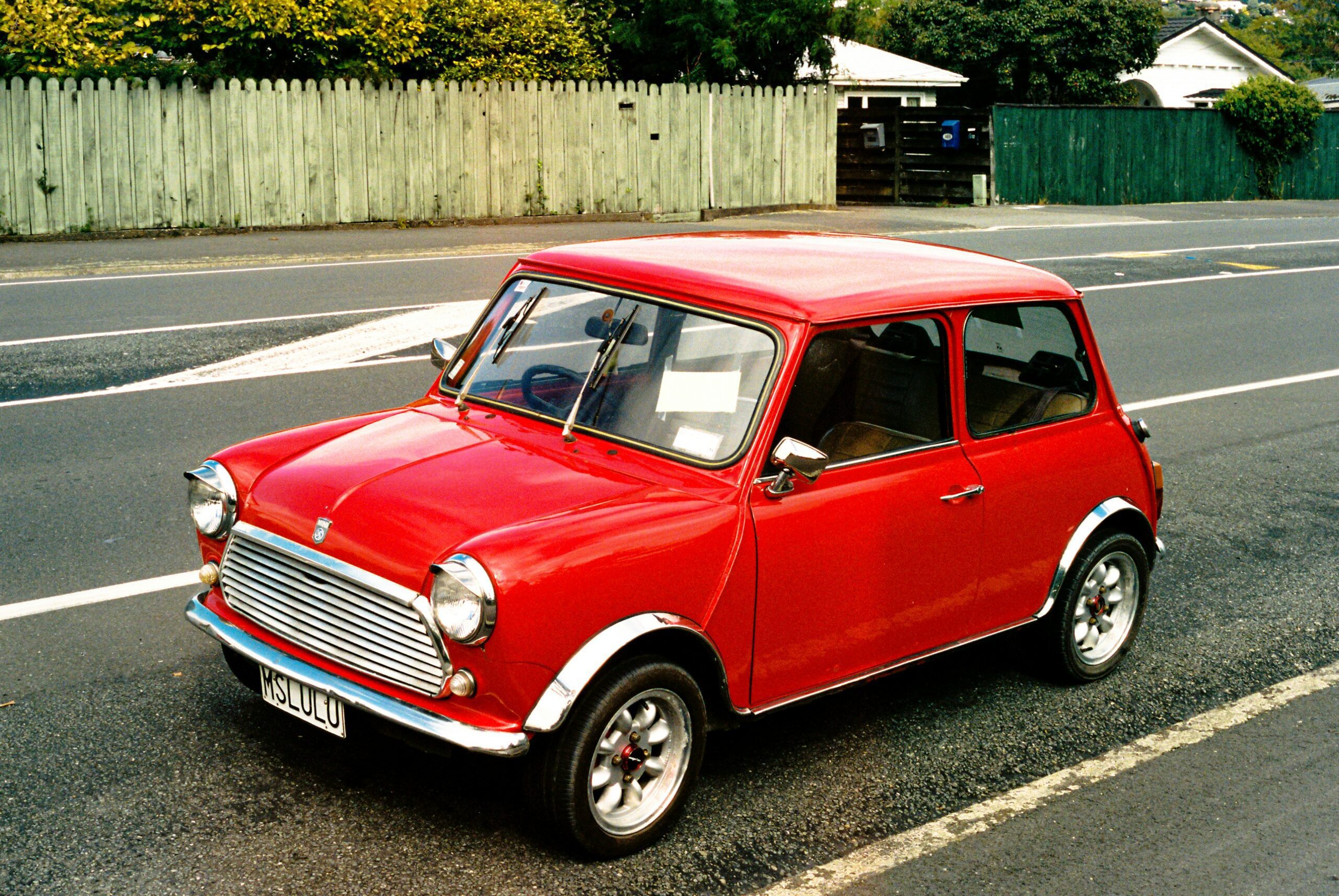
There are very few cars in history that can genuinely claim to have changed the world. The original Mini is one of them. Alec Issigonis’s small miracle, launched on 26 August 1959, redefined what a small car could be, influenced every front-wheel-drive hatchback that followed it, won the Monte Carlo Rally three times, became a cultural icon of the 1960s, and remained in production for forty-one years with the same basic architecture largely intact. Over five million were built. If you have been considering buying one, this guide will help you choose the right car, know what to look for, and understand what you are getting into. Which is, broadly speaking, one of the most entertaining and characterful classics available at any price.
Why the Mini matters
The Mini’s engineering is genuinely revolutionary even by today’s standards, which is a remarkable thing to say about a car designed in the late 1950s. Issigonis mounted the engine transversely, placed the gearbox in the sump below it, and drove the front wheels, all of which is entirely standard practice in modern small cars and was completely unheard of when the Mini appeared. The result was a car that was ten feet long but used eighty percent of its floor space for passengers and luggage, leaving only twenty percent for mechanical components. A conventional small car of the era managed the reverse of this ratio. The Mini’s four passengers sat in more space than a car twice its length could reasonably offer.
The suspension used rubber cone springs rather than conventional coils or leaves, which saved weight and space. The wheels were pushed to the extreme corners of the car. The whole thing weighed under 600kg. The result was a car that handled with a precision and agility that embarrassed much larger and more powerful machinery, a quality that rally drivers discovered almost immediately and exploited with considerable enthusiasm.
It was also, it should be said, astonishingly good in snow. The combination of front wheel drive, light weight, and an almost perfectly even weight distribution meant that Minis went through conditions that defeated much heavier cars. One owner of our acquaintance recalls her Mini navigating snowdrifts deep enough to remove the number plate, which is both a testament to the car’s ability and a reminder that replacement number plates were a standard winter accessory for committed Mini drivers in the 1960s and 1970s.
A brief history
The Mini was produced from 1959 to 2000, initially as the Austin Seven and Morris Mini-Minor, the twin-badge arrangement being a BMC habit that nobody found particularly convincing. The Austin and Morris badges were dropped in 1969 when the car became simply the Mini. Over its forty-one year production life it spawned an extraordinary range of variants including the Cooper and Cooper S performance models, the Clubman with its squared-off front end, the estate, the van, the pickup, the Moke, and various special editions that accumulated in greater numbers as the car aged.
The Cooper S variant, developed with John Cooper of Formula One constructors fame, won the Monte Carlo Rally outright in 1964, 1965 and 1967. The 1966 win was disqualified on a technicality regarding the headlamps that many observers, then and now, regarded as rather convenient for the French organisers. The Minis had finished first, second and third. Whether this counts as a fourth consecutive win is a debate that Cooper S enthusiasts have been having with admirable consistency ever since.
Production finally ended on 4 October 2000 when the last classic Mini, a British Open Classic in Tartan Red, came off the production line at Longbridge. The BMW-owned MINI brand had by then taken the name in an entirely different direction, producing a car that shared nothing with the original except its cultural reference point and a general enthusiasm for go-kart handling.
Which Mini?
Forty-one years of production means an enormous range of variants, specifications and mechanical generations. The broad categories that matter most to a buyer are as follows.
Mk1 (1959 to 1967)
The original Mini with sliding windows, external door hinges, and the distinctive interior with its central speedo mounted on the dash. These are the most characterful and the most desirable to purists. They are also the most expensive for a given condition and the most in need of careful inspection, as good ones are increasingly rare and poor ones are frequently presented as better than they are. The 848cc engine is charming but modest. The Mk1 Cooper and Cooper S are among the most valuable small British classics in existence and should be authenticated carefully before any purchase.
Mk2 (1967 to 1970)
Revised grille, larger rear window, wind-up windows on some variants. The Mk2 is visually similar to the Mk1 but slightly more refined. Good cars are available at accessible prices and the mechanical specification is essentially identical to the Mk1. A Mk2 in solid condition represents good value for a buyer who wants the classic Mini experience without the concours price of the earliest cars.
Mk3 onwards to 1976 (the Clubman era)
The 1970s Mini received wind-up windows as standard, concealed door hinges, a revised interior and various other refinements. The Clubman variant introduced in 1969 had a squared-off Allegro-influenced front end that increased the bonnet length and provided more front crumple zone. The Clubman is considered by most Mini enthusiasts to be less attractive than the round-nosed original, which makes it somewhat undervalued and therefore interesting to buyers who care more about driving than showing. The 1275cc engine fitted to the later Clubman GT is a significant improvement over the 848cc unit.
Late cars (1976 to 2000)
The later Minis received various updates including a revised subframe arrangement from 1976, dry cone suspension replacing the original Hydrolastic system on some variants, and eventually the 998cc and 1275cc engines as standard fitment. The latest cars have the most modern equipment and are the most usable for everyday driving. The 1990s special editions in particular are well equipped and often well preserved having been bought by enthusiasts rather than used as everyday transport. Values for genuinely good late cars have been rising steadily.
[ebay_placement]
The Cooper and Cooper S
The Mini Cooper, developed with John Cooper’s involvement from 1961, transformed the Mini from an economical runabout into a proper performance car. The original 997cc twin-carburettor Cooper produced 55bhp and could reach 85mph, which was entirely respectable for a car of its size and price. The Cooper S of 1963 raised the stakes considerably, with engines of up to 1275cc producing 76bhp and handling that made it competitive with much more expensive machinery in circuit racing and rallying alike.
Genuine Mk1 and Mk2 Coopers and Cooper S models are now seriously valuable and serious fakes exist. A car presented as a Cooper must be verified against its commission number through the British Motor Museum Heritage Certificate service before any premium is paid. The number of Minis currently wearing Cooper badges that left the factory as standard 848cc cars is not small. Buyer beware applies with unusual force in this segment of the market.
What to look for: the rust situation
The Mini rusts. It rusts comprehensively, creatively, and in places that are both structurally significant and expensive to repair properly. This is not a reason to avoid the car. It is a reason to inspect any candidate very carefully and to value a solid body far more highly than a good engine.
Subframes
The Mini uses separate front and rear subframes that carry the suspension, engine and drivetrain rather than mounting these components directly to the bodyshell. This is structurally elegant and makes major mechanical work easier. It also means there are two additional steel structures to inspect for rust, both of which are expensive to replace properly. Check the front subframe mounts where the subframe connects to the bodyshell floor, as these are a specific and well-known rust location. Subframe replacement is a significant undertaking and a car with seriously corroded subframe mounting points needs accurate pricing to reflect the work required.
Sills, floors and A-panels
The sills on a Mini are structural and rot extensively. Probe both the outer sill and the inner sill structure and be deeply suspicious of any outer sill that has been replaced over a rotten inner. The floor pans rust from the inside, particularly under the mats where water collects. The A-panels, the curved panels that run from the base of the windscreen pillar down to the sill in front of the door, are a notorious rust trap and often require replacement on older cars. Check the area around the base of the windscreen and the scuttle for rot, which is extremely common and allows water into the footwells.
Rear subframe towers and wheel arches
The rear subframe towers, the pressed steel structures in the boot that the rear subframe mounts to, are a critical structural element and a well-known rust location. A car with seriously rotten rear towers requires major structural work before it is roadworthy. Check the rear wheel arches inside and out, the boot floor, and the area around the rear light clusters. Outer rear arches are frequently replaced but check that the inner arch and the surrounding structure is sound rather than just the outer panel.
What to look for: mechanicals
The A-series engine
The A-series engine fitted to Minis throughout the production run is one of the most thoroughly documented small engines in automotive history. It is robust, simple, and responds well to regular maintenance. A healthy engine starts readily, idles evenly, and pulls cleanly without smoke or hesitation. Blue smoke on the overrun indicates worn valve stem seals or guides. White smoke that persists once the engine is warm suggests a head gasket. A rattle from the top end on a cold start that clears as the engine warms is usually tappets and is not a serious concern.
The A-series engine shares its oil supply with the gearbox, both running in a common sump. This means the oil you check on the dipstick is lubricating both engine and gearbox simultaneously. The implications are twofold: oil condition matters more than usual because contaminated oil damages both units at once, and any gearbox metal debris ends up circulating through the engine bearings. Change the combined oil regularly, use the correct specification, and check it frequently.
The gearbox
The gearbox sits in the engine sump as noted. It should change cleanly through all four gears without baulking or jumping out of gear. A noisy gearbox or one that jumps out of second or third under load needs attention and the shared lubrication system means ignoring it is not a sensible option. Synchromesh wear on second is the most common gearbox complaint on higher mileage examples.
Hydrolastic versus dry suspension
Minis built between 1964 and 1971 used Hydrolastic interconnected fluid suspension rather than the original rubber cone system. The Hydrolastic units link the front and rear suspension on each side hydraulically, which gives a self-levelling effect and a distinctive ride characteristic. It is a clever system that works well when properly maintained and pressurised. A Hydrolastic Mini sitting noticeably low at one end has lost pressure in the system and needs attention. Later cars reverted to the simpler dry cone suspension which requires less specialist equipment to maintain.
Brakes
Early Minis used drum brakes all round. Disc front brakes became available from the Cooper S and were gradually adopted across the range. Check that the brakes pull evenly and that the handbrake holds on a slope. Seized rear brake cylinders are common on cars that have been lightly used or stored. Brake fluid in the Mini system absorbs moisture over time and should be changed regularly, which on many older examples it has not been.
Interior and practicality
The Mini’s interior is famously compact for the driver and front passenger. The rear seat is a different matter. The packaging efficiency that Issigonis achieved means that rear seat space is genuinely usable in a way that the car’s exterior dimensions suggest should be impossible. Generations of Mini owners demonstrated this practically, and it was not unusual for a Mini to carry four adults in reasonable comfort. Children, being smaller and more compressible, could be accommodated in greater numbers still. This is not a car where the rear seat is a polite fiction, which distinguishes it from most of its contemporaries of similar size.
The boot is modest. The spare wheel lives in the boot on most cars, which reduces it further. Some owners moved the spare to an external boot-lid mounted carrier to recover the space, which is a practical modification that has been common since the 1960s. The opening rear number plate panel on earlier cars provides a small additional storage area that is more useful than it appears.
Common problems summary
- Rust in sills, floors, A-panels, subframe mounting points and rear towers is the defining challenge and the most important thing to assess at purchase
- Subframe rust at the mounting points is structural and expensive to address properly
- Head gasket failure is common on engines that have overheated or been poorly maintained
- Oil leaks from the rocker cover, timing chain cover and rear crankshaft seal are almost universal on older cars and should be expected rather than treated as a surprise
- Gearbox wear is significant on high mileage cars and is worsened by infrequent oil changes
- Hydrolastic suspension losing pressure is common on 1964 to 1971 cars
- Fake Cooper and Cooper S badging is extremely common and premium prices should never be paid without Heritage Certificate verification
- Door seals harden and allow water into the footwells, which then sits under the mats and rots the floor from the inside
What to pay
The Mini market has two very distinct tiers. Standard cars in usable condition ask between £5,000 and £10,000 depending on age, condition and specification. Good restored examples are £12,000 to £20,000. Late special editions in genuinely good condition sit at similar levels. Genuine Mk1 and Mk2 cars in good original condition are increasingly expensive and well-presented examples regularly exceed £20,000. Genuine Coopers and Cooper S models in documented, matching numbers condition are serious money, with the best early Cooper S cars now exceeding £50,000 at auction. Projects and restoration candidates should be below £4,000 and even then require careful assessment of how far the rust has progressed before committing.
Before you buy
The Mini Owners Club and the Mini Cooper Register are both active organisations with extensive technical resources and the ability to assist with Heritage Certificate verification on specific cars. The British Motor Museum Heritage Certificate service is essential for any Cooper or Cooper S purchase and strongly recommended for any early car being bought on the basis of its original specification.
Classic car insurance on an agreed value policy from a specialist insurer is strongly recommended, and the Mini qualifies for historic vehicle road tax exemption with considerable room to spare. Running costs on a well-maintained Mini are genuinely modest. Parts availability from the Mini Spares Centre, Mini Sport and other specialists is excellent across most of the production range, and the accumulated knowledge in the owner community is encyclopedic.
The Mini is not the easiest classic to buy well. The rust profile is serious, the fake Cooper problem is real, and the cheapest examples frequently conceal structural problems that dwarf the saving on the purchase price. But bought carefully, a solid Mini is one of the most rewarding and characterful classics available at any money. It goes around corners in a way that makes no physical sense given its age and its dimensions. It fits into parking spaces that defeat modern cars of twice its length. It is economical, insurable, genuinely usable, and it is quite extraordinarily good in the snow. Even the snowdrifts, provided you are not too attached to your number plate.
Before you make an offer, check current market values with our free classic car price checker — estimated UK values by condition grade with live eBay listings alongside, so you can see what cars are actually selling for right now.
This page contains affiliate links. If you click a link and make a purchase, Classic Car Hub may earn a small commission at no extra cost to you.