
Ten miles south of Oxford, in a town that most people drive through without stopping, there was once a factory that meant more to the world of sports cars than its modest size had any right to suggest. The MG factory at Abingdon operated for just over fifty years. In that time it produced some of the most beloved British sports cars ever built, employed generations of local people who took enormous pride in what they made, and built a reputation for quality and commitment that put larger and better funded facilities to shame. When it closed in 1980 there were public demonstrations in the streets. The Member of Parliament for Abingdon raised the matter in the House of Commons. The man who ordered the closure would later describe it as his only regret. This is the story of how it all began, what happened in between, and how it ended.
The beginning: Morris Garages and Cecil Kimber
The MG story does not begin in Abingdon. It begins in Oxford, in the early 1920s, in a motor dealership called Morris Garages. The dealership was owned by William Morris, the self-made industrialist who had built the Morris car empire from nothing and would later become Lord Nuffield. Morris had little personal interest in the day to day running of his retail business, which left considerable latitude for the man he hired as sales manager in 1921 and promoted to general manager the following year. That man was Cecil Kimber.
Kimber was not a formally trained engineer. He was a self taught enthusiast with a gift for understanding what made a car desirable and the practical ability to do something about it. Beginning in the early 1920s he started modifying standard Morris models, fitting them with sportier coachwork and presenting them to customers who wanted something a little more interesting than the standard product. These cars were sold under the Morris Garages name, with the initials MG worked into their presentation. By 1924 the MG octagon trademark had been registered. By 1925 the business had outgrown its Oxford premises and moved to a larger space in Bainton Road. By 1927 it had moved again, to a separate factory in Edmund Road, Cowley, where for the first time a proper production line was possible.
Kimber’s design philosophy was simple and stated plainly. A sports car, he said, should look fast even when it is standing still. The cars he built in the 1920s were not fast by any absolute measure. But they looked the part, they were affordable, and they were more fun to drive than anything else at the price. That combination proved extremely popular and by 1929 demand had grown to the point where another move was necessary.
The move to Abingdon: 1929
The site chosen for MG’s new permanent home was a former leather works in Abingdon-on-Thames, the old Pavlova Leather Company, which provided considerably more space than the Edmund Road factory. The move took place in 1929. The MG Car Company was formally incorporated as a limited liability company on 21 July 1930, with William Morris as governing director and Cecil Kimber as managing director.
The timing of the move to Abingdon coincided neatly with the launch of a new car that would define what MG meant to the public. The M-Type Midget, introduced in 1928 before the move and developed into production at Abingdon, was the first MG to be widely regarded as a purpose-built MG rather than a modified Morris. It used the 847cc overhead camshaft engine from the new Morris Minor, set in a revised chassis, with a lightweight two-seat body that weighed just 500kg. With 20 horsepower to move it along and a top speed of around 64mph, it was genuinely quick for its day, and it cost under £200. The M-Type became the world’s best-selling sports car in 1932. More than 3,000 were built, making it the most successful pre-war MG model in terms of production. The name Midget, introduced with this car, would remain associated with MG for the next five decades.
The 1930s: racing, records and the golden years
The early 1930s were the most purely exciting years in MG’s history. Kimber understood that motorsport success was the most powerful advertising available and he pursued it aggressively. The factory fielded works cars at Brooklands, in long distance trials, and in record breaking attempts at venues across Europe. Captain George Eyston drove a supercharged 750cc MG, known as the Magic Midget, to 103mph at the Autodrome de Linas-Montlhéry in 1931. In 1932, at Pendine Sands in Wales, Eyston raised the 750cc class land speed record to 119.48mph. These were remarkable figures from a tiny car built by a small factory in a market town in Oxfordshire.
From 1930 to 1935 at least ten different models were produced at Abingdon, including the celebrated K3 Magnette which won its class at the 1933 Mille Miglia. The factory’s reputation for building cars that punched well above their weight was well established both on road and track by the middle of the decade. It was, by any measure, a remarkable period for a company that had only recently moved out of a converted tannery.
Then, in 1935, the situation changed. William Morris, reorganising his various business interests, sold MG to Morris Motors Limited, another of his companies. This seemingly technical change had significant practical consequences. It subordinated Kimber to a new layer of corporate management and shifted design and development responsibilities to the Morris offices at Cowley. Factory racing activities, which had been central to MG’s identity, were shut down by the new management on the grounds of cost. Kimber continued to run Abingdon but with considerably less autonomy than before.
The war years and the loss of Kimber
When war broke out in 1939 the Abingdon factory was turned over to war production, as were most British manufacturing facilities. The factory assembled tank components, repaired military vehicles, and produced nose sections for the Albemarle light bomber. It was this last work that brought Kimber’s time at MG to its end. Frustrated by the slow pace of government contracts being distributed through Cowley, Kimber went out and secured his own contracts directly. This action infuriated his superiors in the Morris organisation and in 1941, after seventeen years of building MG from nothing into a world renowned marque, Cecil Kimber was summarily dismissed.
He died in February 1945 in the King’s Cross railway disaster, never having returned to the company he had created. His daughter said of his death that it was a merciful release, that he had never quite got over being dismissed, and that MG had been his be-all and end-all. Kimber House, the headquarters of the MG Car Club in Abingdon to this day, is named in his honour.
John Thornley and the post-war years
The man who guided Abingdon through its most commercially successful period was John Thornley. Thornley had first come to Abingdon in 1931, persuading Kimber to give him a desk at the factory from which to run the fledgling MG Car Club, of which he was a co-founder. He joined the company formally and worked his way through the organisation, becoming General Manager in 1952 when the merger of Morris Motors and the Austin Motor Company created the British Motor Corporation.
The BMC merger was not straightforward for Abingdon. BMC chairman Leonard Lord had recently signed a deal with Donald Healey to produce the Austin-Healey sports car, and had limited appetite for funding a rival product from Abingdon. Thornley fought persistently for investment in new MG models, and eventually won the argument. The MGA, launched at the Frankfurt Motor Show in September 1955, was the result. Designed by MG chief engineer Syd Enever with a chassis by Roy Brocklehurst, the MGA was a clean, modern sports car that made the previous T-Series look exactly as old-fashioned as it had become. Over 101,000 MGAs were built before it was replaced in 1962, making it by far the most successful MG model to that point.
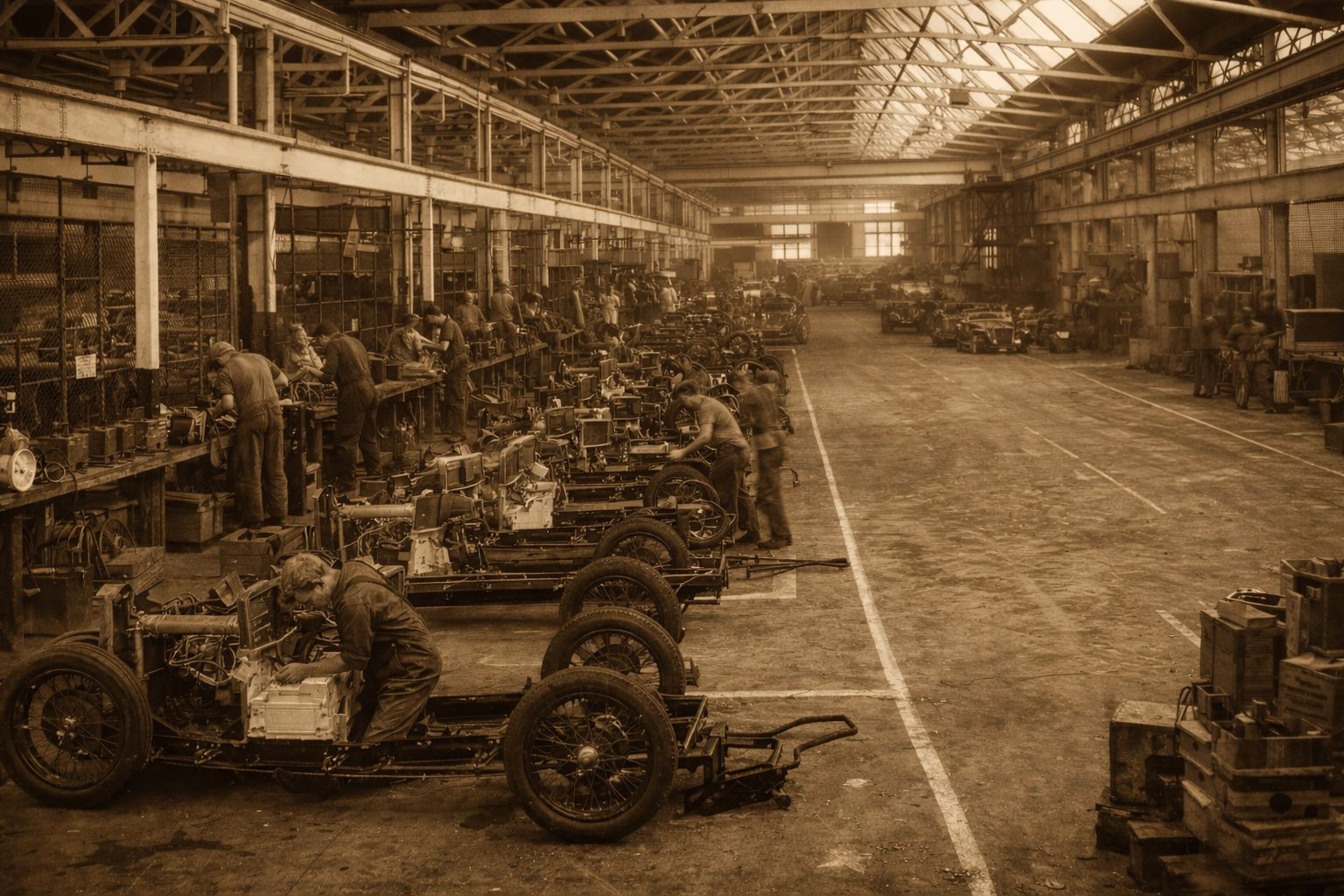
In 1957 the Abingdon factory received an additional responsibility that would shape the next fourteen years. BMC management decided that Austin-Healey production, which had been based at Longbridge, would be transferred to Abingdon. The reasoning was straightforward and slightly backhanded: Abingdon had demonstrated itself to be more efficient and more productive than the larger Austin factories. The compliment was noted. From 1957 onwards the Big Healeys, the Austin-Healey 100-6 and subsequently the 3000, were built alongside the MGs on the Abingdon production lines. At its peak the factory employed around 1,300 people and built roughly 1,000 cars a week.
The BMC Competitions Department
One of the least discussed but most significant aspects of Abingdon’s history is its role as home to the BMC Competitions Department. Thornley had worked with the main board from as early as 1955 to establish a dedicated competitions operation at the factory, and the department became one of the most successful in British motorsport history.
Under competitions manager Marcus Chambers and later the brilliant Stuart Turner, the department prepared and entered cars across the full spectrum of international motorsport. The Austin-Healey 3000 became a formidable rally weapon, with Pat Moss and Ann Wisdom winning the Liege-Rome-Liege Rally outright in 1960, an extraordinary achievement for a women’s crew in a major international event. The Mini Cooper S prepared at Abingdon won the Monte Carlo Rally three times. Works-prepared MGs and Healeys competed at Le Mans, at Sebring and across the European rally calendar. The department was closed when the factory itself closed in 1980.
The MGB: Abingdon’s defining car
The MGB, announced at the Earls Court Motor Show in October 1962, was the car that Abingdon would become most associated with. Designed by Syd Enever and his team, the B replaced the separate-chassis MGA with a proper monocoque body, giving more interior space, better structural rigidity, and a more modern feel while retaining the accessible, affordable character that had always defined the marque. The 1798cc B-Series engine gave adequate performance and the car was well received from the start.
The MGB GT, a fastback coupe version with a body partially developed with styling input from Pininfarina, followed in 1965. The MGC, a six cylinder version of the MGB using a new 2912cc engine, was produced from 1967 to 1969. The MGB GT V8, using the lightweight all-aluminium Rover V8 engine, ran from 1973 to 1976. In total, across all variants including the MGC and V8, more than 523,000 examples were built over eighteen years. The MGB was, by any measure, the most successful British sports car ever made.
The Midget returns
In 1961 the MG Midget name returned after an absence of over two decades. The new Midget was, in practical terms, a rebadged and slightly upmarket version of the Austin-Healey Sprite, the two cars sharing the same body and mechanical package while wearing different badges and interior trim. The arrangement was characteristic of BMC’s approach to the market and was entirely transparent to anyone who looked closely, but it served its purpose. The Midget sold well alongside the MGB for nearly two decades, giving customers a smaller and more affordable entry to Abingdon’s range.
The contract with the Healey Motor Company for the Sprite expired in 1971 and was not renewed. The Austin-Healey name disappeared and the car continued as the MG Midget alone until production ended in December 1979. Between 1958 and 1979 Abingdon had produced 354,164 Sprites and Midgets combined.
The British Leyland years
The formation of British Leyland in 1968, through the merger of British Motor Holdings and the Leyland Motor Corporation, placed MG in a complicated and ultimately damaging position within the new organisation. Triumph, MG’s long-standing rival, was grouped with Rover and Jaguar in the Specialist Division, while MG was placed in the Austin-Morris Division alongside the mass market cars. This organisational decision had practical consequences throughout the 1970s. New Triumph models including the TR7 and the Dolomite received investment. No new MG sports car was developed. The MGB and Midget soldiered on with incremental updates and increasing emissions-related detuning for the American market, becoming progressively further removed from the spirit of the original cars.
Through all of this the Abingdon workforce maintained a record that stood in stark contrast to the industrial relations chaos elsewhere in British Leyland. While factories at Longbridge, Cowley and Speke were convulsed by strikes, walkouts and go-slows, Abingdon produced cars with minimal disruption for over twenty-five years. It was, as one British Leyland spokesman would later acknowledge, a superb work record. It did not save the factory.
The closure: September 1979
In September 1979 British Leyland organised a two-day celebration at Abingdon to mark the factory’s fiftieth anniversary. It was a well attended and convivial occasion. Few of those present knew it was essentially a farewell party. The following Monday, BL chairman Sir Michael Edwardes announced that the Abingdon factory would be closed at the end of the 1980 model year as part of a plan to cut the company’s workforce by 25,000 and close thirteen factories. The Midget and the MGB would both be discontinued. Abingdon was finished.
The announcement provoked an immediate and passionate response. Former managing director John Thornley organised a letter writing campaign asking MG dealers to oppose the closure. North American dealers threatened legal action. Public demonstrations took place in Abingdon. A consortium led by Aston Martin chairman Alan Curtis assembled a group of businessmen and offered British Leyland thirty million pounds for the factory, the MGB’s tooling and the rights to use the MG name. The offer was seriously considered and negotiations ran for months. By the time the Aston Martin group was ready to proceed it had run into its own financial difficulties and could no longer fund its share of the deal. The consortium collapsed in the summer of 1980. Abingdon’s fate was sealed.
The last MGB came off the Abingdon production line on 23 October 1980. The factory closed the following day. Sir Michael Edwardes, who in every other respect regarded his radical restructuring of British Leyland as necessary and correct, would later describe the closure of Abingdon as his only regret during his time as chairman.
What the factory made
The Abingdon factory is remembered almost exclusively for MG sports cars, which is understandable. But the full list of vehicles built there is considerably wider. From 1949 to 1957 Abingdon also built Riley saloons. From 1957 to 1971 it built Austin-Healeys alongside the MGs. Between 1960 and 1964 some Morris Minors were assembled there. In 1979 and 1980, in the final months of the factory’s life, Vanden Plas 1500 saloons were also produced on site. The factory’s reputation for careful, skilled hand assembly made it the natural choice within BMC and later British Leyland for low volume and specialist models that could not be efficiently handled on conventional mass production lines.
Abingdon today
The site of the MG factory is now partly occupied by Abingdon Business Park. Two of the original factory buildings survive, reclad and unrecognisable to most passers by. The administration block known as the Top Office still stands on Cemetery Road. The MG Car Club, one of the oldest single-marque clubs in the world, has its headquarters at Kimber House on Cemetery Road, positioned on the edge of what was once the factory site. The last MGB Roadster built at Abingdon is on display at Abingdon County Hall Museum, lifted through a first-floor window in 2011 because the Grade I listed building could not accommodate it any other way, which seems a suitably eccentric end to a suitably British story.
The MG name has continued in various forms since 1980, through the badge-engineered Metros and Maestros of the 1980s, through the MG RV8 and MG F of the 1990s, and eventually under Chinese ownership through SAIC. None of these chapters has quite the same resonance as the fifty years when MG meant Abingdon, and Abingdon meant MG. The town and the car were inseparable in a way that no subsequent chapter of the story has managed to replicate. It remains one of the more melancholy endings in British industrial history, not because it was unusual but because it was so entirely preventable, and because the people it affected had done so little to deserve it.
This page contains affiliate links. If you click a link and make a purchase, Classic Car Hub may earn a small commission at no extra cost to you.